Went for a run this morning and I can’t think of a better way to start Christmas. Whilst my wife and elder daughter went to church, I ran alongside the canal. In our own way each of us were contemplative and felt in touch with the wider world - before we got down to the serious business of opening presents.
My run felt fresh. There were few people about - the odd dog walker and some couples out for a stroll - so I was determined to greet all of them. This is not my normal behaviour as us southerners are trained at an early age to avoid all eye contact and act as if we are invisible. I was thus not cheery and effusive but even my limited greeting was a bit too much for some people. Others though were really warm and that made it feel like Christmas day.
Down by the canal there were some narrow boats with smoke coming from their stoves and the smell of the burning coal was quite evocative. Open coal fires are now a rarity so the smell takes me right back to my early life. Even beyond that as I thought of early photographs of the canals and industrial towns, with smoke coming from a mass of chimneys and a black pall. From a few canal boats the smell can be nostalgic but it also remind us of how quality is now o much better. (I say this of course from Hemel Hempstead, which had an enormous black cloud of smoke overhead for a good few days).
There were other things that heightened the reality of the run. A woman dressed as an elf loading presents into a car made me smile, seeing kids out on new bicycles was just how it should be and the peeling of the church bells as I returned to the High Street brought everything together.
To all of you who read this have a very happy Christmas and to all of you who have posted comments in the past I would like to say how much I have appreciated them.
Sunday, December 25, 2005


Sunday, December 11, 2005
Smoke
No running today - it's probably not a good idea to be out breathing in the smoke fumes from the fuel depot explosion.
I have no dramatic stories to tell. I was asleep at 6am when I stirred to see my wfe looking out of the window. "wasssupp?" I mumbled. "There has just been a big explosion and the house shook" she replied "Oh" I said and fell back to sleep again. I have a really impressive, hair trigger, emergency reflex.
It was just like the big hurricane of 1987 when I slept through the whole thing and was only woken by the telephone. When I answered I sounded like a complete numpty, not knowing a thing about what had happened.
It is really rather strange today - I look out of the window on one side of my house and the sky is dark, whilst on the other side the sky is blue and bright.
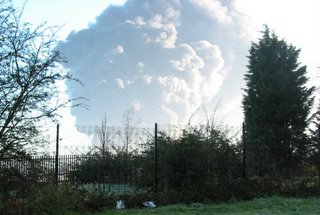
I have no dramatic stories to tell. I was asleep at 6am when I stirred to see my wfe looking out of the window. "wasssupp?" I mumbled. "There has just been a big explosion and the house shook" she replied "Oh" I said and fell back to sleep again. I have a really impressive, hair trigger, emergency reflex.
It was just like the big hurricane of 1987 when I slept through the whole thing and was only woken by the telephone. When I answered I sounded like a complete numpty, not knowing a thing about what had happened.
It is really rather strange today - I look out of the window on one side of my house and the sky is dark, whilst on the other side the sky is blue and bright.

Friday, November 18, 2005
Faster Smaller / Slower Larger
There is a lot of concern with the pace of modern living, with endless articles about stress, long hours, and the pressure of constant availability. Road rage is a symptom of anxiety about having ones progress checked, computer rage happens when things don’t work properly and take longer than expected, shopping rage happens when other people get in the way.
A lot of rage and a lot of expectation that everything can be done quickly and then quicker again.
There have been two recent books on the subject: Faster by James Gleick and In praise of slow by Carl Honoré. The first is really a descriptive list of ways that things have speeded up. The other book is more interesting because it has a central idea that things have gone too far and need to change.
The moment of epiphany for Carl Honoré was seeing an advert for One Minute Bedtime Stories and initially thinking it was a good idea. Then his brain kicked in and he started to think about what was important in putting your kid to bed and reading and how real communication takes time to develop.
The other side of the need for speed is that things have to be smaller and more digestible i.e. reduced to a size we can encompass in a glance. If the world is seen from the window of a speeding car then the scale is lost.
The importance of running is that it is a paradoxical antidote. One of the aims is to train to increase your speed. What is a race but going as fast as you can?
But this can only be achieved slowly. There are no short cuts. Training takes as long as it takes, as you cannot cheat your body. At the core of a training schedule is the long slow run – the building of endurance by running comfortably. You go at your own speed, it you try to go faster you will not last the distance.
The other thing is that you are part of the landscape and everything is in its proper scale. You can recover your sense of wonder at the landscape, or at buildings. Not only can you see things afresh every time you run, you actually feel the distance. Your physical capabilities limit your span and keep everything in proportion.
There is a poem by Theodore Roethke, The Waking:
I wake to sleep, and take my waking slow.
I feel my fate in what I cannot fear.
I learn by going where I have to go.
We think by feeling. What is there to know?
I hear my being dance from ear to ear.
I wake to sleep, and take my waking slow.
Of those so close beside me, which are you?
God bless the Ground! I shall walk softly there,
And learn by going where I have to go.
Light takes the Tree; but who can tell us how?
The lowly worm climbs up a winding stair;
I wake to sleep, and take my waking slow.
Great Nature has another thing to do
To you and me, so take the lively air,
And, lovely, learn by going where to go.
This shaking keeps me steady. I should know.
What falls away is always. And is near.
I wake to sleep, and take my waking slow.
I learn by going where I have to go.
All you have to do is replace the word wake with run.
Friday, November 04, 2005
Why I did not run
Some months ago there was a Doonesbury cartoon where Mike asked his daughter what she thought of the appointment of John Bolton to the UN. She replied that he was just another right wing ideologue who never got over the left wing ideologues of his youth. You boomers are still refighting the 60s and since you are now running the show the rest of us have to suffer for it.
On the public level there might be a lot of truth in this observation but is it also true privately? I have therefore been spending some time sifting through my interest, beliefs and views to see what is hung over from the 60s and 70s - not only what I thought and did but also what I missed. One of the questions was: why did I ignore the first running boom?
The easy answer is that I never enjoyed running much at school. I was not a particularly competitive athlete (I suppose I just about attained mediocrity), but was fairly good at ball games. Running was thus something you did to get to the ball not something to be done for its own sake. Not only that, it was about bursts speed and uncomfortable if maintained for any length of time. But this is nowhere near the full answer.
At heart though I was not really serious about sport. I dropped organised team games by the age of 20 and what was left was a mixture of pick-up games or squash or tennis with friends. There were cultural reasons for this – there was a big divide between the social attitudes of a rugby club and the aesthetics of the counter culture. I was more interested in the latter.
Running should then have been the perfect sport, with none of the sports-jock, rugger-bugger ethos and being about self-actualisation. But I didn’t think of it that way – if I was not competitive, it was exercise and the idea of exercise for its own sake was alien. This is one of the great changes in social attitudes over the past 30 years. It is now generally acknowledged that exercise is a good thing in itself and running has helped bring this about. At the time however I was behind this curve, and exercise was just an unacknowledged by-product of activity. I was fit because I cycled 14 miles to work everyday but I never thought about it as sport - it was transport.
In this I showed a continuity of attitude with my parents (who were always active but in a purposeful way). So at a time when I had been questioning a lot of the social attitudes of my parents’ generation I actually shared some of their values.
Looking back I see even more of those continuities.
Letters to an Intimate Stranger
Rummaging through the jumbled attic I like to call my mind I thought about Jack Trevor Story.He was someone who took pride in being a professional writer, a craftsman, who wrote with great style and humour. In the 70s he wrote a well-regarded saturday column in the Guardian, that was later collected and published under the title ‘Letters to an Intimate Stranger’.
I think is a wonderful title and I remembered it because it is now a perfect description of what we do with blogs. I will sometimes write things I haven’t told other people and I am always impressed by the openness of the blogs I read.
But if we are intimate strangers I think the word 'strangers' needs to be redefined.
I think is a wonderful title and I remembered it because it is now a perfect description of what we do with blogs. I will sometimes write things I haven’t told other people and I am always impressed by the openness of the blogs I read.
But if we are intimate strangers I think the word 'strangers' needs to be redefined.
Monday, October 24, 2005
A post around three quotes
This is really a follow on from my last post about turning my back on technology – to get back to basic training.
Its not base training – I am not bothered about trying to go long at a steady 70% of MHR – I rather like mixing up pace. All I seek to establish are good habits – a regular pattern of exercise rather than the erratic boom and bust that has characterised my progress up to now. But consistency is always difficult.
So my only objective at the moment is just 4 exercise sessions a week. 3 of them can be anything but the long (or longish) run is fixed.
If I do this I will be able to congratulate myself on some consistency.
That is why I have to do basic training.
Its not base training – I am not bothered about trying to go long at a steady 70% of MHR – I rather like mixing up pace. All I seek to establish are good habits – a regular pattern of exercise rather than the erratic boom and bust that has characterised my progress up to now. But consistency is always difficult.
“I ache in places where it used to play” (Leonard Cohen – Tower of Song)Everything has to be done within the constraints of a crumbling body. At the moment I have rotator cuff tendonitis, my shin is still a weakness and cannot be pushed to hard, my left hamstring is sore and my right quads do not feel too clever – oh and the plantar fascii of my left foot ache a bit as well. All of these things are niggles rather than big flaring injuries but I do not want them to get worse. They are constantly in the back of my mind and I do not think I can do heavy mileages at the moment. I can only try to establish a pattern that is sustainable and then gradually take it from there. Its not bad and when I run things are fine but I am a bit fed up with listening to my body - I wish it would just shut up for a bit.
“Out of the crooked timber of humanity nothing straight can ever be made” (Kant - Idea for a Universal History from a Cosmopolitan Point of View 1784)One of my personal weaknesses is an inability to stick rigidly to any plan. Everything I do has to take account of the way that the grain of my character is warped in this particular way. I am always tremendously impressed by people who can see clearly what needs doing and then do it. I wish I was more like that but I am not. I have to work by indirection instead.
So my only objective at the moment is just 4 exercise sessions a week. 3 of them can be anything but the long (or longish) run is fixed.
If I do this I will be able to congratulate myself on some consistency.
“All our knowledge begins with the senses, proceeds then to the understanding, and ends with reason. There is nothing higher than reason.” (Kant, Critique of Pure Reason)My basic training is an attempt to understand the sensations of running and the way my body reacts. With that I can start to apply reason and become more structured in my approach. But at the moment running is for me mainly sensation i.e. the base level.
That is why I have to do basic training.
Tuesday, October 04, 2005
Out with the Garmin! Out with the HRM!
It is not quite as dramatic as that. I have not done some extreme life-laundry and thrown away all of my clutter. In fact I have not so much abandoned these tools as they have abandoned me. The first to go was the Garmin - it would not stay on for longer than 30 seconds. A couple of months later I broke my heart rate monitor, or rather broke the fixings that hold the watchstrap in place.
Although the Garmin has now been replaced, it was away for about six weeks and during that time I got used to running without it. Similarly with the HRM, my first instinct was to buy a new one straightaway, but I hesitated and now I am wondering if I need it at all. I am quite happy running by how I feel and only measuring the time I take. It is not just that it is simpler - I don’t really need the extra information.
The Garmin, for example, never changed my training. I just looked at the results, and although I was impressed by all the figures and thought it was fun, that was all. The HRM did change my behaviour as I used it on long runs to keep my heart rate below a certain level. However I now find it much easier and more direct to use my breathing as the guide.
If I were a finely tuned athlete trying to run to the absolute height of my powers, then close monitoring of every session, an accurate assessment of every variable and a comparison with the training plans would be appropriate. Lance Armstrong treats his body like a precise piece of machinery and wants to know everything about the way it performs. His results show the benefits of that approach. However, even if I was younger, never by any stretch of the imagination could I be like him. And as I am there is just too much fat, both literal and metaphorical, to cut before precision has any meaning.
All I need to do is go back to basics and establish a regular routine and carry on doing this until I feel I am ready for more structured training. Then I might want the toys again but until then all that matters in time on feet and for that a watch is good enough.
In fact it is better that that - it is liberating. No more spitting on the strap and adjusting it so that it has proper contact and then fiddling around when the heart rate gets random, no more waiting around for the satellite signals to lock. All you have to do is put on your shoes and run.
Simple - and afterall this should be a simple sport.
Wednesday, September 21, 2005
No one possess the truth
In today’s Guardian there was an article praising the virtues of the novel and its importance in times of growing intolerance. The full article can be found here but the key paragraph is:
I had not come across the quotation by Milan Kundera before, so when I read it it was fresh and I almost shouted out loud some inanity like “that is so right”. Novels can increase our understanding by encouraging an inclusive form of thinking that recognises characters/people on their own terms. When you look at Mrs Bennett in Pride and Prejudice she is not just silly and ridiculous. She is a woman with anxiety about the future well-being of her family in the face of a genuine problem, whilst her husband, a much more intelligent and sympathetic character, locks himself in his study and avoids the issue. In the best novels, as in life, things are not black and white.
Surprisingly it is the same with running. On one level there could not be a more clear cut sport –you run so far in such a time. There is no dispute and the winner of the race is the one who goes fastest. Simple.
Except that it isn’t. It is not the reason I run. It is not the reason that hundreds of thousands of people plod along the streets. Most of us will not be near the front of a race and so we need other motivation – and in that motivation there are a host of different stories and criteria of success. Some people want to prove themselves through competition whilst others want to prove to themselves that they can run to the end of the street. Some want to loose weight and feel better about themselves whilst other just want the satisfaction of movement. Some people are pushing themselves hard, others are introducing a balance into a sedentary life. The wonderful thing is that all reasons are valid and there is as much strength, determination and virtue at the back of the pack as there is at the front.
Understanding people’s hopes and expectations and being able to celebrate their successes enlarges us all and also makes us realise that there is no one-way to do things. No one possess the truth.
In that way running is just like the novel.
The genius of the novel, according to Kundera, is that it is able to accommodate multiple moral universes, each interacting with the other, without the need to subjugate any one of them to some all-encompassing conclusion. The novel is pluralism in action. As Kundera puts it: the novel is "the imaginary paradise ... where no one possesses the truth, neither Anna nor Karenin, but where everyone has the right to be understood, both Anna and Karenin".
I had not come across the quotation by Milan Kundera before, so when I read it it was fresh and I almost shouted out loud some inanity like “that is so right”. Novels can increase our understanding by encouraging an inclusive form of thinking that recognises characters/people on their own terms. When you look at Mrs Bennett in Pride and Prejudice she is not just silly and ridiculous. She is a woman with anxiety about the future well-being of her family in the face of a genuine problem, whilst her husband, a much more intelligent and sympathetic character, locks himself in his study and avoids the issue. In the best novels, as in life, things are not black and white.
Surprisingly it is the same with running. On one level there could not be a more clear cut sport –you run so far in such a time. There is no dispute and the winner of the race is the one who goes fastest. Simple.
Except that it isn’t. It is not the reason I run. It is not the reason that hundreds of thousands of people plod along the streets. Most of us will not be near the front of a race and so we need other motivation – and in that motivation there are a host of different stories and criteria of success. Some people want to prove themselves through competition whilst others want to prove to themselves that they can run to the end of the street. Some want to loose weight and feel better about themselves whilst other just want the satisfaction of movement. Some people are pushing themselves hard, others are introducing a balance into a sedentary life. The wonderful thing is that all reasons are valid and there is as much strength, determination and virtue at the back of the pack as there is at the front.
Understanding people’s hopes and expectations and being able to celebrate their successes enlarges us all and also makes us realise that there is no one-way to do things. No one possess the truth.
In that way running is just like the novel.
Friday, September 02, 2005
River view
It's been I long time since I returned from holiday yet all I have done is post a couple of holiday snaps and then walk away. Almost as if I had become disengaged from the blog and associated conversations. There have been two main reasons: the first is an effort to cut down on the amount of time I spend in front of computers; the second is a general feeling of blankness and a desire to not repeat myself too much.
The first reason is positive - something I brought back from holiday where the evenings were spent outside, eating , drinking, talking, doing stuff. It felt good and I resolved to do more with my evenings - do stuff, or in other words try to tackle my backlog of tasks. Now that I am fresh fro the triumph of decorating the bathroom I feel I can backslide a bit and do some browsing and typing.
The second reason is totally negative. In an attempt to do something about this feeling of flatness I left work early today to go to the Tate Modern. Leaving aside the artworks, it is a place I sometimes go to think. The Members Room has one of the best views in London - you feel you can almost reach out and touch the dome of St Paul's. I sat on the balcony and looked across at the city and thought about how much of my life was bound up in the place. My eyes flicked around and I associated memories with buildings and places. Blackfriars and the amazingly ornate art nouveau pub, the Mermaid Theatre and thoughts not of plays but of being in the audience to see the first performance of Metropolis by the Mike Westbrook Concert Band and the joyous noise of a freeish big band.
My gaze then moved back to the BT Tower, a building that from this distance still looks modern after 40 years. I thought about my father who used to work for Post Office Telecommunications (as it then was). Around me were people talking into mobile phones and in his working life he could never have imagined how phones could become not just important but an extension of some peoples bodies.
The age in which he tried to estimate traffic and plan capacity is a world away. He used to tell the story of how he was partially responsible for the Whitgift Shopping Centre in Croydon opening without enough telephone lines. He had surveyed the area on a summers day. The Whitgift School, which had been there since Tudor times, was picturesque and from the playing field he could hear the crack of bat on cricket ball. He thought it was timeless - at most over the next five years they would need 10 extra lines. Shortly after that the school sold its land for redevelopment planning needs were not well enough communicated and there wasn't enough exchange capacity.
I then looked down at the riverside and people strolling in the sun, enjoying themselves. There were some kids on skateboards and also a few runners. Looking at those runners in an area rich in personal associations I remembered why I write this blog - I want to talk about the engagement through physical activity with landscape through and with the imagination.
So feeling suitably pretentious I had better start posting again!
Sunday, August 07, 2005
Blue Remembered Hills
When I run at home the colour is green. The canal is lined with trees whose leaves colour the view and on the edge of my vision are grassy fields or a golf course. Ashridge, has trees, ferns and commons – mostly green. In Canada there was a lot of blue. Although the mountains were covered in trees they always looked blue from a distance and when we were by the sea or the lakes there were shimmering layers of water, hills and sky.

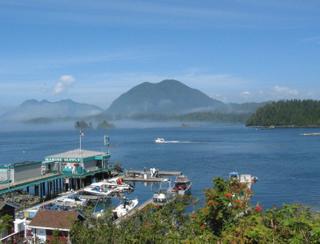

Here are a couple of examples:

Miracle Beach on the east coast of VI looking out over the Georgia Straits towards the mainland.

Looking out from Tofino on the Pacific coast.
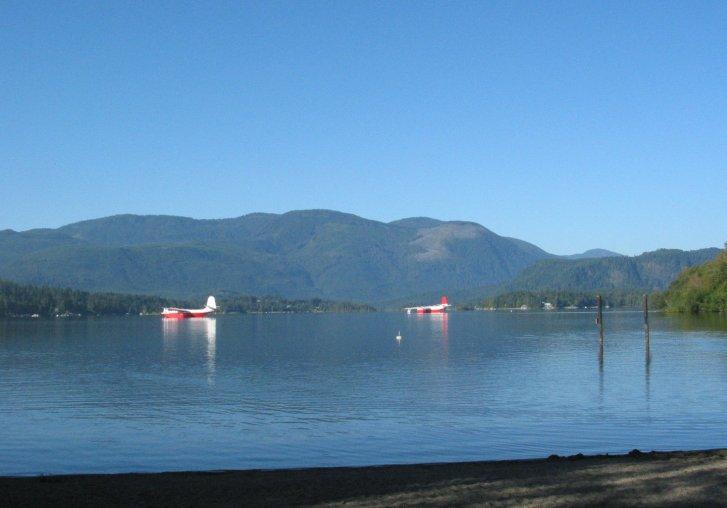
Fire planes on Sproat lake
This sense of colour probably doesn’t mean much but running in the landscape did feel refreshing. “First the body. No. First the place. No. First both. Now either. Now the other.” I am strongly affected by the landscape when I run. Somehow I want to feel part of the land; also I want views to distract me – when the going gets tough I want to be able to look up and convince myself that I am doing this for enjoyment.
When I looked at the mountains or the water I stood a bit taller and probably ran a little bit slower. Not that I did much mileage, mostly they were small runs at the start of day – but through running easy I discovered the value of the filler run. It gives rather than takes energy and sets up the day.
There were a couple of wildlife encounters to spice the interest; the most exciting of which was seeing a cougar. My wife and I were running a forest trail outside the campsite at Goldstream when we heard a crashing through the undergrowth about 30 metres away, up the hillside. At first we thought it a deer or large dog but when we looked closely we recognised the movements of a large cat and the markings of a cougar that had been disturbed by the sound of our heavy footfalls.
Another time, when I was by myself, I came close to a deer. We looked at each other, both standing very still, after a couple of minutes the deer sidled away, still keeping eye contact, before ruining off into the woods.
There was plenty of wildlife – watching eagle became almost commonplace and plenty of views. Above all there was space.
Coming back from Canada always feels the same – everything feels crowded and a bit claustrophobic. But I am now back, still a bit hazy but beginning to adjust... It is home after all.
Saturday, July 16, 2005
This Blog is going on Holiday
It is holiday time and tomorrow we fly to Vancouver to visit my sister and go camping on Vancouver Island.
Here are some pictures of the campsites we have booked:
Goldstream,
Sproat Lake
Miracle Beach
So for a few weeks this blog will blogs will sleep.
In the meantime I will give you my recommendation for holiday reading. Inspite of its title it is not about running. It is a novel about someone who finds himself on a quest, almost by accident. Without a plan he cycles across America to identify the body of a sister initially lost through madness. He meets people who help him and others who he helps; through this he remembers the person he was before his life atrophied. Intertwined in this is the story of his sister, the love he had for her and the effect she had on the family. It is not a gloomy book - there is a lightness and humour.
I can justify the recommendation on a running blog because one of the themes is the way daily physical activity, a little at a time, can add-up to become a great endeavour, which can then reconnect you with yourself.
Here are some pictures of the campsites we have booked:
Goldstream,
Sproat Lake
Miracle Beach
So for a few weeks this blog will blogs will sleep.
In the meantime I will give you my recommendation for holiday reading. Inspite of its title it is not about running. It is a novel about someone who finds himself on a quest, almost by accident. Without a plan he cycles across America to identify the body of a sister initially lost through madness. He meets people who help him and others who he helps; through this he remembers the person he was before his life atrophied. Intertwined in this is the story of his sister, the love he had for her and the effect she had on the family. It is not a gloomy book - there is a lightness and humour.
I can justify the recommendation on a running blog because one of the themes is the way daily physical activity, a little at a time, can add-up to become a great endeavour, which can then reconnect you with yourself.
Tuesday, July 12, 2005
Life goes on - it always does
This is a running blog and one of the constraint I set myself is to try to try to stay on subject, even if the link might be a bit tenuous So far it has not been a problem, and I have found things I wanted to say but between Thursday and Sunday this was not the case.
I was not personally affected by the bombings in the sense that I was nowhere near them when they went off and I know nobody who was directly involved. I am not someone who reacts to external events with great emotion and my life is much as it ever was. But, and this is rather a large but, my mental landscape was empty – like a ghost town in an old western, where the only movement is a tumbleweed blowing down the street. I had a constant sense of eerie quietness.
Thursday itself was very strange. I only knew something was wrong when colleagues phoned-in saying that they were having difficulty getting into work because the whole underground network was closed down because of power surges or a security alert. The rest of the day was spent trying to get work done with fewer people whilst constantly checking on the Internet to see more news. There was a horrible obsessiveness about reading the same things again and again to see if there was any more information. I finished about 7pm and ran to Euston (4 miles)to catch my train home. It was a most unpleasant run, where everything felt wrong. I felt wrong and the city was all wrong - theatres, bars and restaurants were closed and even Covent Garden was subdued. But I did not feel the emptiness until I got to the Euston Road. It was closed to all traffic - so still, so quiet.
It was then that I remembered the Potters Bar rail crash. On that day I had been at a meeting in an office block in the concourse of Potters Bar station. Our party was breaking for lunch, just walking down the stairs, when we heard the crump of the crash. We ran to the station and were amongst the first people there - trying in some way to help and not really knowing what to do.
When I think of what happened I don’t really remember what I saw: the broken bodies on the track, looking like puppets whose strings had been cut, or the way the carriage was wedged under the platform roof at a crazy angle. Instead I feel the stillness. Everything was quiet, disconnected and empty – and that is what I still feel inside myself. On thursday it all came back.
After that I did not want to write about running but I did want to run. So on Sunday I went back to my canal and my base run. It was leafy, beautiful and peaceful and, although it was a bit too hot and I suffered more than usual, at the end I was uplifted. My spirits were restored.
Now once again I want to write about running. The whole point of this blog is to try to record those moments when the simple act of putting one foot in front of another for a longish period of time can transform the way you feel. Make you once again feel connected. It is what I am trying to express.
Sunday, July 03, 2005
A good animal
In my post ‘Running Retreat’ I mentioned that one of the objectives of running was to become a ‘good animal’ . That phrase was not mine; I found it, via George Sheehan, from this passage by Herbert Spencer:
“Emerson says of the gentleman that the first requisite is to be a good animal, and this is the first requisite for every one. A course of life which sacrifices the animal, though it may be defensible under special conditions is not defensible as a general policy. Within the sphere of our positive knowledge we nowhere see mind without life; we nowhere see life without a body; we nowhere see a full life–a life which is high alike in respect of intensity, breadth, and length–without a healthy body. Every breach of the laws of bodily health produces a physical damage, which eventually damages in some way though often in an invisible way the mental health.” (Herbert Spencer - ‘The Principals of Ethics, Vol. 1 Part III: The Ethics of Individual Life’, Ch. 5)
If it is important, and I believe it is, to look after our physical health, then it is important to know our animal nature. In the running manuals this is often glibly referred to as ‘listening to your body’ – it sounds fairly straightforward but it is not.
When we spend days sitting indoors, travelling, shopping, meeting, eating, drinking – just doing the normal things; it is very easy to become disconnected. We cannot interpret the messages. Is it an ache or a random twinge? Is that pain a message of damage or just a transitional stage, as things get stronger? Even the straightforward things are not clear. If you stand upright and close your eyes do you know that you are straight and balanced, or do you unconsciously favour one side or another, are you leaning forward or back?
Listening to your body can be a bit like being tone deaf at a concert – you know in principle what is happening but you can’t quite work out the detail.
For me part of the activity of running is learning to strip away all the rust and corrosion that has gathered around my senses and so feel myself in space. Part of that involves taking responsibility for what I do to my body and what it needs. Another part is learning to trust my basic animal nature and the wonderful machine I have inherited – finding out how strong and resilient it is, by learning and experimentation.
I do not think my body is especially wonderful (you just have to look at me to see it is not). I think all of us have great capabilities because that is how we evolved – after all our ancestors could out-run the antelope. It is that history I am trying to glimpse.
Now read how someone else has pursued that goal far more effectively than I could ever hope.
Thursday, June 23, 2005
It's the everyday things
Although I have been running since the stress fracture mended, my left leg has never felt quite right. There have been all sorts of aches and twinges just above the ankle and a dull ache along the plantar fascii; however there has been lack of pattern to the aches and I have been unable to tie them to any run or type of activity. As a precaution I have therefore been cautious in mileage, surface and speed – just sort of ticking along really. This does nothing to increase my fitness and I have needed large dollops of faith to believe that everything will be OK in the end.
Now I actually believe things will be all right because I have had one of those blinding eureka moments when another example of my stupidity became clear. The problems are the result of my posture at work, where a large part of the day is spent in front of a computer. Without being aware I have tended to sit for long periods with my legs bent backwards under the seat, on the toes of my left foot with my right ankle resting on my left Achilles. This has stressed my tendons with a passive weight and kept the plantar fascii under tension – not very clever. When this suddenly became clear I stopped. Magically my foot has started to feel easier. I am now making a conscious effort to sit straighter, be more balanced, and keep both feet on the ground in front of me. This must be good.
It only goes to show that not everything on your run is caused by running. What we do throughout the day: how we hold ourselves, how we move, how much we move, all contribute to how we run. If we repeatedly put our body out of balance we will create a weakness that running will magnify because the pounding of running makes it an attritional activity like water on the landscape.
The problem is that most of what we do during the day is habitual and unconscious and it is difficult to be continually aware and know whether we are doing the right thing.
I think I will just have to try harder.
Now I actually believe things will be all right because I have had one of those blinding eureka moments when another example of my stupidity became clear. The problems are the result of my posture at work, where a large part of the day is spent in front of a computer. Without being aware I have tended to sit for long periods with my legs bent backwards under the seat, on the toes of my left foot with my right ankle resting on my left Achilles. This has stressed my tendons with a passive weight and kept the plantar fascii under tension – not very clever. When this suddenly became clear I stopped. Magically my foot has started to feel easier. I am now making a conscious effort to sit straighter, be more balanced, and keep both feet on the ground in front of me. This must be good.
It only goes to show that not everything on your run is caused by running. What we do throughout the day: how we hold ourselves, how we move, how much we move, all contribute to how we run. If we repeatedly put our body out of balance we will create a weakness that running will magnify because the pounding of running makes it an attritional activity like water on the landscape.
The problem is that most of what we do during the day is habitual and unconscious and it is difficult to be continually aware and know whether we are doing the right thing.
I think I will just have to try harder.
Friday, June 17, 2005
Not a training run
I am not sure whether it shows a healthy state of mind or not but today I have taken a holiday, just so I can do a long run. The weekend will be taken up with a family wedding and running time will be curtailed. So the run had to be today – and I am really glad it was. The temperature was perfect, the trees were beautiful and there was hardly anybody else about.
I have two areas for my long runs: the canal, which I have talked about at length and Ashridge. Today was Ashridge.
I have two areas for my long runs: the canal, which I have talked about at length and Ashridge. Today was Ashridge.
“Running across the borders of Hertfordshire and Buckinghamshire and along the ridge of the Chiltern Hills, this area comprises a series of common-pasture woodlands, chalk downland and commons. Once a medieval deerpark, this estate covers some 5,000 acres. Walkers will enjoy the 16-mile boundary walk or the six shorter self-guided trails. Points of interest include the Monument, built in 1832 in honour of the third Duke of Bridgwater, the pioneer of Britain’s canals, and there’s a visitor centre near here too. A good time to visit the estate is late spring for a dazzling display of bluebells, and you can take in some super views too, if you climb Steps Hill to Ivinghoe Beacon. Look on the estate for a good number of surviving ancient oak and beech trees. Frithsden Beeches is not surprisingly a good area for the latter, whilst Berkhamsted Common and Aldbury Common are good locations for the oaks.” (Woodland Trust)
There are still plenty of deer and this morning two herds crossed my trail. The first time they were just milling about, the path was dappled with sunlight and there was a sense of quietness and peace. I looked at them for a while and then continued; they then ran off but I was smiling.
These moments lift the spirits and it is one of the reasons why I will not describe today as a training run. Training implies that what you are doing is preparation for something else whereas this is what I run for - it is the whole point. It does not mean that I will not put in training miles – there will always be those. It just means there are some days when you realise what the training is for.
Looks like this is another entry in my manifesto for the soft-core runner - except I don't want it to sound as if its written by some bucolic Polyanna.
Sunday, June 12, 2005
Running retreat
There is an article in today’s Observer about the growing popularity of retreats that contains:
Adam Phillips, the psychoanalyst and writer, is not surprised by the growing popularity of retreats: 'People are aware of having too many external stimuli. What do you hear when you stop listening? The question is about whether anyone has an internal world any more.'
This is what running provides. Every week my long run is the equivalent of a retreat, because there is nothing but the movement of the body through space. This can happen automatically – you get into a rhythm and the body takes care of itself allowing the mind to be blank or drift onto various topics so that attention can drift. Alternatively there can be full attention and one is aware of how the muscles and breath are working together. In a similar way you have a sense of the space you are moving through, either through having to pay close attention to the ground because when you are off-road you have to be careful where your foot lands or by having a more generalised appreciation of the landscape, which tends to come in and go out of focus.
Through running you discover your animal core and without that I do not believe you can have a complete sense of being. Running is obviously not the only way to do this; yoga, for example, stretches the body to prepare the mind for meditation. I find running a better route because it is simpler, more direct and rhythmic. However I only really get a sense of oneness on long runs. In one of my earlier posts about injury I quoted Joe Henderson saying that when he was not running he really missed the short, nondescript, filler runs. With me that is not the case - I easily drop those. What I miss, and miss with great interior agitation, is the long run and the chance (as it does not happen every time) of getting to the state of sensing the body with an empty mind.
I think this forms part of my manifesto for the soft-core runner. The hard-core runner is deeply wedded to stats and targets, mileage and times (mostly long and short, in that order) but I am soft-core and my objective is the ineffable sense of being a good animal. Through that, eventually I might become a better person. (The might and eventually are heavily underlined in the last sentence).
Sunday, May 29, 2005
Sourcing quotes and the extraordinary
In George Sheehan's 'Personal Best' there are a number of quotes from philosophers and writers that have some bearing on running. Mostly they are well chosen and crystallize a particular point, however none of them are referenced. They are introduced in a really lazy way like: "Emerson said...", or even worse " A French sociologist pointed this out.. ". I don't know who is at fault, an author who can remember a quote but not its source or a publisher who does not want to clutter up a page with footnotes. Whoever it was does not matter, the other person should have insisted on proper standards. Even a popular books should allow the reader to follow-up its content, through an index and references.
I particularly wanted to look at a quote from Jean-Paul Sartre:
I particularly wanted to look at a quote from Jean-Paul Sartre:
"Only in games is man free because only in games does he understand what is going on"
I have no idea of its source and Google has failed me; so I will have to keep on looking. However the search is not without its rewards - not only have I decided to reread Roads to Freedom I have also found this quote from Nausea:
" I believe the word adventure could be defined: an event out of ordinary without being necessarily extraordinary."
This is a great definition of how I view running. When you look at the population as a whole, what we do is out of the ordinary but it is for the most part not extraordinary. There is however the possibility for the extraordinary, even the heroic. This report from Andy Collier about his completion of the Lanzarote iron man despite being ill with a stomach bug is a case in point. I don't know whether his endurance and bloody mindedness is exemplary or stupid, but it is certainly heroic.
The other thing that shines out from is account is the behaviour of Matt who offered both kindness and support out a sense of community. I think that is the great thing about triathlon or running. Mostly we are alone in our practice but we are also part of a community who share an understanding of what we are trying achieve and what we need. We are never really alone.
Wednesday, May 18, 2005
Now is the time
I like near-science when it confirms my prejudices.
I have never believed in the idea of new year resolutions. Always I start the year by thinking of things I would like to see happen but tend not to do anything about it until about now. This is obviously the right approach because the day to start your new life is May 18
It is just so difficult to motivate yourself at the beginning of the year when the days are short and the weather is grey and cold. It is not a time to diet because your instincts tell you that you need comfort and warmth. It is not the time for training for the same reason. So for those who did a spring marathon - I salute you. I think it is much tougher than running in autumn when you can train on warmer days, in the light.
Me I'm planning for autumn.
I have never believed in the idea of new year resolutions. Always I start the year by thinking of things I would like to see happen but tend not to do anything about it until about now. This is obviously the right approach because the day to start your new life is May 18
It is just so difficult to motivate yourself at the beginning of the year when the days are short and the weather is grey and cold. It is not a time to diet because your instincts tell you that you need comfort and warmth. It is not the time for training for the same reason. So for those who did a spring marathon - I salute you. I think it is much tougher than running in autumn when you can train on warmer days, in the light.
Me I'm planning for autumn.
Tuesday, May 17, 2005
What did I learn?
On Sunday I went for my first long run for ages. Through the woods of Ashridge, amongst the bluebells with the leaves scattering light in speckled patterns – and I felt nothing, not a twinge, not the slightest tenderness. My injury and rehabilitation is over and it is time to consolidate the lessons.
1. First and most obviously – running is experience. Thinking or talking about it is no substitute because you have to feel your immediate experience.
2. Suffering an injury makes you painfully aware of the consequences of your own actions. Whilst I had previously paid lip service to the idea of being careful and trying to run injury free, I did not fully feel it and did not really pay full attention. I had previously been able to experiment with different patterns of training without adverse consequences and so I thought my body was stronger than it actually was. I have been stripped of that illusion and know I have to always keep hold of that sense of frailty.
3. I have identified my area of weakness and that gives me something to work on - a way to improve.
4. There is nothing so damaging to your running fitness as not running – obvious but true - so taking unnecessary risks is stupid. Gradual progress is optimum progress, however I know I am prone to stupidity and need to constantly remember this.
5. Running is not the only exercise. By working on other parts of my body I actually feel stronger and these new routines need to be incorporated into my ongoing pattern. In particular I have been working on core muscles and shoulders. I have a theory that you need strength there to maintain form over the long distance.
6. All the exercises in the gym just feel like preparation - they are not an end in themselves, whereas running is fully sustaining.
However all that is mere mechanics the most important lesson is that running is incredibly important to my sense of being. It also makes me easier to live with. I found this out at a dinnertime conversation on the subject of shop names when I said my favourite was ‘Run and Become’. “Become what?” Asked my younger daughter. “Whatever you can be,” I said “It ‘s a path not a clear objective” “Yes” said my wife “you are far more content and relaxed when you are running”.
I don’t want to become a grumpy old man.
Monday, May 16, 2005
Water
How do we know something is true?
I don’t want this to be a post about life, the universe and eternal verities – this is after all a running blog – but it is important to know that advice we receive is well founded. It is important to know that any science has been accurately reported and translated and the sources can be checked. If advice is based on experience then that experience must be directly described with all the circumstances to allow the reader to separate the more general lessons from the particular, individual instance. Then we can make judgements.
Sometimes, however, I worry that things are assumed to be true just because they are frequently repeated. Take hydration – apparently you should drink 2 litres of water (and only water) a day otherwise you risk chronic dehydration. This is an example of that sort of assertion from the BBC website. I know this is not a from a sports site and the article drifts off into something that should be savaged in ‘Bad Science’ in the Guardian ( I particularly enjoyed the electromagnetic memory of water and the idea of implosion research has a sort of charm), but I have seen similar water advice in a number of places.
In particular there is a lot of anti-caffeine prejudice. As someone who mostly drinks a mixture of coffee, tea and green tea I find this very tiresome. I have drunk like this most of my adult life and have not become progressively dehydrated and shrivelled like a prune (although my brow is rather too furrowed). My favourite recovery drink after a long run is a big mug of tea and I don't want to change that – so I will continue according to the motto that if experience contradicts the theory; stick with the experience.
However there is no contradiction. This article on the urban myths site Snopes seems to be the sort of balanced assessment I like - it means I do not have to change my ways. The worrying thing is that it cites a self-published book as the main source of the myth about chronic dehydration. How can such a publication have such a big influence?
One of the consequences of the Internet is that it allows rumour and speculation to be passed off as fact because of a weight of repetition. Alomost anything can spread like a virus. It is thus increasingly important to check sources and always ask: how do I know this is true?
I don’t want this to be a post about life, the universe and eternal verities – this is after all a running blog – but it is important to know that advice we receive is well founded. It is important to know that any science has been accurately reported and translated and the sources can be checked. If advice is based on experience then that experience must be directly described with all the circumstances to allow the reader to separate the more general lessons from the particular, individual instance. Then we can make judgements.
Sometimes, however, I worry that things are assumed to be true just because they are frequently repeated. Take hydration – apparently you should drink 2 litres of water (and only water) a day otherwise you risk chronic dehydration. This is an example of that sort of assertion from the BBC website. I know this is not a from a sports site and the article drifts off into something that should be savaged in ‘Bad Science’ in the Guardian ( I particularly enjoyed the electromagnetic memory of water and the idea of implosion research has a sort of charm), but I have seen similar water advice in a number of places.
In particular there is a lot of anti-caffeine prejudice. As someone who mostly drinks a mixture of coffee, tea and green tea I find this very tiresome. I have drunk like this most of my adult life and have not become progressively dehydrated and shrivelled like a prune (although my brow is rather too furrowed). My favourite recovery drink after a long run is a big mug of tea and I don't want to change that – so I will continue according to the motto that if experience contradicts the theory; stick with the experience.
However there is no contradiction. This article on the urban myths site Snopes seems to be the sort of balanced assessment I like - it means I do not have to change my ways. The worrying thing is that it cites a self-published book as the main source of the myth about chronic dehydration. How can such a publication have such a big influence?
One of the consequences of the Internet is that it allows rumour and speculation to be passed off as fact because of a weight of repetition. Alomost anything can spread like a virus. It is thus increasingly important to check sources and always ask: how do I know this is true?
Subscribe to:
Posts (Atom)