Wednesday, October 03, 2012

Zebra Finch


This is an inconsequential little post but I wanted to show one of the strangest sights I have come across on a trail. It was on a walk in a small nature reserve in Saintes and I was so busy looking up and around that I almost missed this tiny bird burrowing into the grass of the path. A tiny zebra finch, completely unfazed by the presence of people. We got close but it was not at all agitated. It carried on so calmly i began to wonder if it was incapable of flight but after a time it hopped up and flew to a nearby branch. So it was just used to people. It must have been a household pet escaped from its cage. I wonder how long it will last i the wild? 

Back from Holiday


Back from holiday and it is  time to get back to some blogging.

We went, as we do most years, to a small village in south west France not far from Cognac. and it is the best running country I know. A rolling, open landscape with few hedges but an occasional lines of trees and small areas of woodland. You can see for miles, the sky is big and the light wonderfully clear. Criss-crossing are plenty of small, empty roads that make planning a route of any distance a doddle. As the land is undulating there is always some challenge so you know you have done some work but without the grinding intimidation of really steep slopes. 

In the height of summer you have to get out early before it gets too hot but nearer to autumn there is more latitude. Getting out at 8 - 8:230 was just fine. Once out the feeling is one of peace. Obviously the landscape is highly cultivated and everywhere there is evidence of people and  their work but with hardly anybody about you can feel you are on your own. You can stretch out without any sense of being crowded, and it encourages you to look around. Overhead there are birds and I am particularly taken with a buzzard who patrols the area - it is his. But you don't have to look at anything in particular: the sense of openness is enough.

The picture shows another feature - the allotments scattered around all the villages. This is a reminder (even if this particular allotment has mostly been harvested) of what I like about France - the food. Not the most unusual of insights perhaps but nevertheless true. Whether it is the restaurants or the riot of colourful vegetables in the markets, there is much that tastes good. 

So there you have it, my holiday defined in one short sentence: run a bit and eat a lot. Perhaps not a recipe for tip top fitness but as a holiday plan there is a lot to recommend it.

Monday, September 03, 2012

Running is Overwhelmingly Honest


It's one of the things I keep repeating: "running is honest', "running is honest", "running is honest". (Imagine I am panting this as a sort of mantra). It is all about personal truth and recognising that whatever dreams you may have about your own special qualities you are never any better than your time. The clock tells how good you are and how you compare with others and it is not susceptible to special pleading. There are no excuses - that is exactly how good you are. How you react is different and a matter of temperament and priorities. You can believe you are capable of much more and so train harder and smarter to improve, or you could accept it and say that you don't (or can't) spare any more time or energy and are happy to be as good as you are within the constraints you have imposed on yourself. Both responses are good, both are honest.

What you cannot do is lie. You cannot make up your times and pretend to be speedier and more athletic than you actually are. It not only goes against all morals and cuts against the reason for putting in the miles. Real runners should not lie. Running is about proving things to yourself. There might be an element of display, talking to others about your times and what you have done, but that happens out of obsession rather that boastfulness. In essence you are trying to find-out your capabilities and that is all that matters.

Running is honest and humbling. You know where you stand in the order of things, The shape of achievement is like a teardrop with most of us in the middle or bottom. For some people, with an inflated opinion of their own abilities (who believe that are born to be special) or a deranged need to be seen by others as exceptional, this is a problem. They might like running but find it is hard to cope with being demonstrably average. So some (I am sure it is a very, very tiny number) are tempted to lie and cheat, ignore the morality of the sport and move to the dark side.

There is a fascinating piece in the New Yorker about a middle aged dentist, Kip Litton, who has gone to enormous trouble to create the persona of a very fast masters runner. Many sub 3s marathons complete with intermediate chip times. However there are few race photos and little corroborating evidence from other runners. There have been doubts and  after investigation disqualifications.The evidence is overwhelming that his times are fictitious but there is still a mystery as to how he did it. He went to enormous trouble to pull off the illusion and even created his own race with other imaginary competitors. But why? I can only guess that he  had some pathological need to be seen as more than a small town dentist leading an average life. I suppose every activity will at some point attract such fabulists.

So what of politicians why would they lie? (Sorry if that seems like a dumb question). They deal in images and pictures, in describing a world that is all sunshine (if their policies are fully implements) and broken and rusting (if the policies of their opponents are implemented). Speeches are full of generalities and suggestion, with the aim of emotional connection rather than reasoned, evidence supported argument. Not quite telling the full truth is a stock in trade. However there is a line between that and telling an outright lie, which is usually observed, even if things are sometimes a bit blurry and sometimes it is difficult to tell the difference between a misrepresentation and a falsehood. It is all part of the game. But there seems a chasm in integrity between fudging policy details  and telling a flat-out lie about yourself and your personal history.

Paul Ryan is the vice-president running mate of Mitt Romney and obviously wants to present himself as fit, energetic, and eager. In an interview he was asked if he still ran he replied: 
"Yeah, I hurt a disc in my back, so I don't run marathons anymore. I just run ten miles or less." When what his personal best is, Ryan replied, "Under three, high twos. I had a two hour and fifty-something."
Any runner knows this is just not credible. It's not that he might not have been capable of running sub 3 (who knows? He looks very fit) but that if he had done so he would know his precise time. it is not something you forget. You can only run a marathon that quickly after a lot of high quality training. It doesn't just happen. It is the culmination of years of work that dominates large parts of your life and becomes an important part of who you are and how you see yourself. After all that effort as sure as hell you remember your time.

No wonder Runner's World were suspicious and tried to check. In the end they found he had run one marathon in 1990 in 4 hours, 1 minute and 25 seconds. Now that is not bad at all and is a time many people (including myself) would be happy with but it is a world away from sub 3. It is not even the same type of race. It is not fudging your time with a bit of haziness. It is an outright lie

The thing I can't understand is why would he make something like that up. Saying you have run a marathon gets you enough brownie points why would you feel the need to pretend something more? My guess (and it is only a guess based on absolutely no evidence) is that he could not admit to being merely an average runner and was compelled to present himself as super fast. It also suggests he is a fantasist with an inflated idea of his own capabilities. In his dreams he would like to be that quick. So would I but the difference is I know it could never happen. He thinks he can pretend it already has.

I began racking my brains for some British equivalent of a politician who would lie about themselves and thought of Jeffrey Archer and the way he embellished his own biography. The difference is Jeffrey Archer was a genuinely quick athlete who represented Oxford University (although, of course, he was probably not entitled to).

Friday, August 31, 2012

Panorama Part 2 - shoes

Source: http://www.hgtv.com/landscaping/pretty-pots/index.html


The second part of the Panorama programme was about the claims of the running shoe industry. 
I don't want say anything about the barefoot vs cushioning debate (that ground has been well tilled in every runners forum for the past few years). Instead I want to mention one of those coincidences that can happen when you are thinking about one subject: something totally unrelated can become relevant. In this case an article in the latest London Review of Books about D H Lawrence's attitude to products of the modern world, the organic vs inorganic, the authentic vs inauthentic.
A world away from the claims of  Adidas and Nike you would assume, even if the essay title was 'Lady Chatterley's sneakers'. But no! Connie wore tennis shoes to meet Mellors in the woods and tennis shoes had crepe soles, which are at a less processed type of rubber product, i.e. not vulcanised, and at an interesting point in the continuum between natural and synthetic.  It is therefore obvious that any literary scholar worth his salt would discuss the efforts of the Rubber Growers Associations to promote the use of crepe shoes in the 1920s (oh do keep up!).
Some of their advertising was quoted:
‘The cushion of “live” rubber lessens fatigue and makes walking a pleasure,’ the advertisements claimed, ‘adding hours to endurance and a spring to every step.’ For nothing had been done, chemically or otherwise, to ‘impair the natural live quality and nerve of the virgin product’.
When I read it I was taken right back to the Panorama programme and the realisation that in essence the sales pitch of sports shoes has hardly changed. It might have added a sciency gloss but we still want something to help our endurance and give us more spring and if the current promotions for barefoot running shoes are about anything they are about being more natural.
The companies are still selling the same dreams.

Wednesday, August 29, 2012

Panorama on sports drinks


A month or so ago Panorama ran a programme on sports products (drinks, shoes, supplements) and really I had no intention of writing about it. The conclusion that we are oversold the benefits of these products is not startling and the style (which now seems to be the default for factual programmes) of having the presenter as an active participant, undergoing test, whilst making dramatic statements was a little tedious - so I didn't feel like saying anything.  But that was before things warmed up with a bit of academic venom.

Mark Burnley wrote this response and his lack of regard for Tim Noakes is quite obvious. Tim Noakes has replied and so we have a dispute about hydration and reputation that has a certain amount of animus but leaves me, as an outsider, feeling there is something else going on and I lack a bit of background. It probably relates to claims by Noakes that his work on the dangers of over drinking were suppressed by people and organisations in thrall to the sports drinks industry (in other words a conspiracy) and people on the other side thinking their integrity had been impugned. As they are all big boys and can take care of themselves they can get on with their fight. I'm not too interested in their relative personal honour, my concern is with the advice given to and the understanding of mid and back of the pack runners. This subject the Panorama programme addressed.

It was not "one of the most biased programme I've ever seen" neither was it a hatchet job on sports science. It was about the marketing of sports products and the way exaggerated claims might create a false impression of what was necessary for exercise. It stated quite clearly in the introduction that ⅕ of us go to the gym and 12 million take part in sport so their is an eager market for sports products and so they wanted to examine the claims made by companies. It was not an evaluation of sports science as a subject but about how science based claims were over leveraged.  In the case of sports drinks, the fact that they are sold in supermarkets and shifted in quantities far in excess of the number of endurance sessions suggests a number of people either like the taste (and are therefore drinking too much sugar) or believe they are necessary when they are not. In that context the programme's message that unless you are going long water is fine seems uncontroversial. Use of the drinks was not dismissed out of hand (they said they worked for athletes like Mo Farah and were good for endurance) but there was a concern that an exaggerated impression of their effectiveness and an overemphasis on hydration might lead to over drinking.

This is important because hyponatremia has caused death in some marathons and it has been the case, in the recent past, that marathon runners have been encouraged to drink as often and as much as possible - advice that cause this condition. (I have been to a marathon training camp where such advice was given). Although the official guidelines are much more conservative, old ideas can be persistent, especially if they are simple and to the point. 'Drink as much as you can' is easy to remember and act upon in a race and so hangs around. The importance of 'drink according to your thirst'  is not only that it is safer but also it is just as simple and easy to act upon. It therefore has a chance of replacing the older message. I thought the programme got this across quite effectively.

One of the Oxford scientists made an important point. The claim that performance deteriorates significantly if you dehydrate by 2% of bodyweight ("just" 2% in the Powerade literature) is widespread and oft repeated but in a marathon you can't action it. You cannot know how much you have lost at any one time, so out of fear of losing too much you will overcompensate. When you are running you work on simple rules of thumb and if you believe not drinking enough will be bad you will do all you can to make sure that doesn't happen. The operational understanding should be reversed: if you drink too much bad things could happen with the consequence that errors would be on the side of caution. A different mindset and one counter to a deep-seated cultural outlook: that if something is good then more is better (which is perhaps why drinks companies are so successful).

I'm sure there were some contributions to the programme that were edited out, perhaps they talked about optimum levels of hydration and and conflicting information. I don't know. I'm sure they would have been interesting if it had been a Horizon on the current state of scientific knowledge (and that would be a programme I would like to see) but this was Panorama. It was primarily about marketing distortions or myths and the way big companies can influence  our attitudes. Sometimes it doesn't matter very much but sometimes it does; but as information transfer is increasingly mediated by corporations we need to be ever more vigilant of the consequences. It is an important subject.

So there you have it. I saw a different programme to Mark Burnley. I saw something aimed at the more casual exerciser and general public. It looked at the science but only to the extent it was used to justify marketing claims and it was not about the overall state of that science. I didn't think it was great but neither did I think it terrible. I would however like to give this assurance as an outsider: I really did not come away with the impression that "sports science research was being conducted by either clueless muppets or industry shills"

Monday, August 06, 2012

The Meaning of Sport

Source: BBC


Saturday was probably the most exciting day of sport I can remember. Although the night, with its three GB athletics gold medal was uplifting and extraordinary in its own right it was only the culmination of a day of highs (mostly highs) and lows.

In the velodrome there had been the sight of the GB women's pursuit team, perfectly drilled riding for one another for their sixth consecutive world record. Such a relentless power applied with an economy of effort where only the legs seemed to be moving, was a wonder to watch. Afterwards at the medal ceremony the stadium was filled with noise as the whole crowd, led by Paul McCartney sang Hey Jude. It could have been a little bit cheesy but it wasn't. It was joyous. Community, celebration, connection between crowd and performer - everything was there.

Also there was a moment that showed something of the person within an athlete. Jo Rowsell took off her helmet to reveal a mostly bald head with a couple of tufts of hair. From the age of 10 she has suffered from alopecia and has had to grow into womanhood without one of the great signifiers of beauty (and to see what an important signifier hair is you only have to look  at the lustrous lock in any shampoo advert). It must have been  difficult but according to this article  cycling has helped build her confidence.  Wonderful - but it still takes a deal of courage to show the whole world your bald head and I am sure every alopecia sufferer will walk a little bit taller after having seen it.

That would have been enough for a normal day but there was much more. On the water there were two greatly contrasting rowing moments. One was an expression of joy and disbelief on the face of Katherine Copeland after she and Sophie Hosking had won their race. Wide eyed and opened mouthed she looked as if she could not believe it but in her expression she showed all the tumultuous emotion of sporting triumph and the reason people put themselves through so much. The other moment was the obverse - the pain of defeat.  Mark Hunter and Zac Purchase battled with the Danish crew and lost by the slimmest of margins to win silver rather than gold. They were so exhausted afterwards that they had almost to be lifted out of the boat and to give an interview to TV they had to prop each other up. They were distraught and the only thing they could think of saying was to apologise to everybody for letting them down. They had let nobody down. They had been heroic but because they did not meet their own target they felt the burden of the whole team upon their shoulders. (read Zac Purchase's account here).The interview went no further there was nothing anybody could say as everybody was moved and Steve Redgrave gently helped them away to a place of privacy where they could recover. If you ever wanted to see how people can invest every fibre of their being in a quest and what that means at the end, you only have to watch that clip. 

And so onto the evening in the athletics stadium where there was nothing but joy. Obviously winning three gold medals in one night is something that the GB team never do. It is impossible but somehow it happened. Not only that it happened to the people you would want. Greg Rutherford, the slightly surprising winner of the long jump has had to endure many ups and downs, injuries and a failure at Beijing that made him feel like giving up, so to eventually come out on top is one of those stories you want to happen. Nothing more can be said about Jessica Ennis and the gracious, sunny way she has born the burden of being the face of the games and the top medal hope. As for Mo Farah - well I just shared the joy and excitement of the BBC commentators.

But later there was something just as significant. At the press conference some numpty journalist asked whether he would have preferred to represent Somali rather than GB Mo Farah replied  "Look mate, this is my country. This is where I grew up, this is where I started life. This is my country and when I put on my Great Britain vest I'm proud. I'm very proud...To win the Olympics in the place you grew up and went to school just means so much to me."

Stick that in your pipe all those miserable people who complained about the multiculturalism of the opening ceremony. This is who we now are: a nation of many peoples and it is great that through the Olympics we have come together to celebrate it

Body Type, Aptitude and Skittles


One of my favourite moments of commentary from the Olympics on Friday was when Tomasz Majewski celebrated his victory in the shot put by running across the track to the crowd whilst the women's 10,000m was being raced. "He better not collide with them or he will scatter them like skittles." You could see his mental image: one big beefy man, a row of slight women and cartoon like fun. 

It highlighted was the way different body types are suited to different sports. Rowers for example tend to have a huge aerobic capacity and great endurance but I wouldn't fancy many of them in a marathon. Similarly you would not put any money on a basketball team made up of cyclists.  It is an obvious point but one that stopped me being convinced by the argument that champions are only made by focused hard work. I enjoyed Bounce by Matthew Syed and thought it contained lots of interesting evidence which showed most people could be better than they ever believed possible, if they practiced properly, with enough intensity, for enough hours. Nevertheless to be a champion, you have to have the right physical equipment for your event. You have to have enough aptitude to make the work worthwhile. The success of British cycling comes applying all the lessons of directed practice, analysing the different components of the sport and making sure no stone is left unturned. The athletes in their programme lead a disciplined rigorous life but before they are admitted they undergo all sorts of tests to make sure they have the necessary physical characteristics, the necessary talent. They know what is required and have identified people outside the sport with the requisite power and aerobic profiles and then encouraged them to take up cycling. Lizzie Armistead is an example. She had never even owned a bike before the age of 15, seven years later she has an Olympic silver medal for the road race. Champions are made from a mixture of talent, hard work, mental strength.

For the rest of us though aptitude is not so important. We can do what we want if we like it. we persist we will improve and in doing so affirm our own sense of worth, even if objectively we are at the back of the pack. For example I am not really built to be a distance runner, my shape is all wrong, but that does not stop me finding satisfaction in plodding along the canal. I can look at the slender frame of Mo Farah with limbs proportionally long and wonder at the sheer elegance of his stride and the beauty of his movement and know, that even if I had started as a young boy and worked as hard as possibly, I could never have approached his level of grace. That is fine I am not a competitive athlete my pleasure is more contemplative, more about the sensation of moving through the landscape, feeling the air, feeling the body working.

I may not be a natural but on the upside though I am not so susceptible to being scattered like a skittle

Monday, July 30, 2012

If only more people cycled


Recently there was a romantic piece in the Independent by Rob Penn on the joys of cycling. It concluded with a paragraph that sums up the reason why so many of us spend so much time on the roads cycling or running, on the hillsides walking or scrambling:
If you've ever experienced a moment of awe or freedom on a bicycle; if you've ever taken flight from sadness to the rhythm of two spinning wheels, or felt the resurgence of hope pedalling to the top of a hill with the dew of effort on your forehead; if you've ever wondered, swooping bird-like down a long hill on a bicycle, if the world was standing still; if you have ever, just once, sat on a bicycle with a singing heart and felt like an ordinary man touching the gods, then you share something fundamental with Bradley Wiggins, and you have reason to cheer him down the Champs-Elysées tomorrow.
It is a wonderful expression of how all of our individual efforts are connected.
But wait - scroll further down the comments column and there is antipathy and fear. It is amazing how many people have a visceral hatred of cycling because of boorish people who ignore the rules of the road and assume they can maintain a high speed in cities by relying on everyone else to get put of the way. I hate those people myself and can be as angry as anyone when jumping back to avoid a cyclist who will not stop for the lights. That is not cycling - it is selfish inconsiderate behaviour,  which happens in almost any form of human endeavour. But the images are so strong it is all some people think of when they think of cyclists.
The loathing must be countered because there is a growing momentum behind the idea that if more people use the bike for transport the health of the nation will be hugely improved. But for that to happen the infrastructure needs to be improved and that  means money and, for the first time in living memory, not putting the car first. In other words a radical step that requires at least the tacit support of a majority of people, so people who don't cycle themselves need to be persuaded that such measures are for the general good. Not easy, especially when you look at the reaction to some of the Olympic traffic lanes and proper, separated cycle lane would have the same effect. It can be done though as Holland and Denmark have proved but our culture is slightly different and we have a vociferous 'Top Gear' faction that makes such change difficult. 
Changing hearts and minds is always long and difficult but if it happens and more people cycle the idiots, the lycra louts,  seem less representative and the roads will also be safer. More people will feel the sense of exhilaration described by Rob Penn and fewer people will die prematurely through the diseases of sedentary living. 

It is an argument worth making.

Saturday, July 14, 2012

Sport can mean something


Source: Associated Press


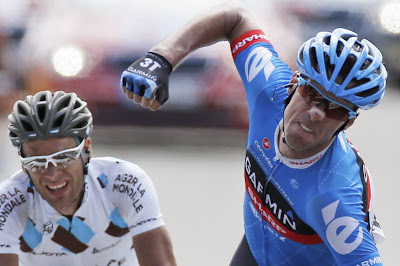
Even with the Olympics still to come and a number of other great sports stories that have already happened (who, for example, would ever have believed that a long-term journeyman tennis player, barely able to scratch a living, would, as a wildcard entry, win the Wimbledon doubles title?) I already know what sporting achievement will give me most delight in 2012. It happened yesterday when David Millar won Stage 12 of the Tour de France.
The stage itself was the least of it - a long breakaway, with a small group managing to stay away right to the end is worth cheering but is not in itself enough; such breaks are regularly attempted and each year one or two succeed. Even though David Millar initiated the move and demonstrated his skill at road racing, that is still makes it no more than a very good win,  not a great sporting moment. No those happen when some part of the story of the day transcend the mechanics of the event to make the victory mean more than a win. In this case, in Annonay Davézieux, it represented redemption.
Even though most people are now aware of the David Millar story it is worth repeating. He started in the sport when the organisation of British cycling was an amateurish shambles and so as a young man he did what all ambitious cyclists had to do: leave for Europe to find a team to learn what professional road racing really was. At that time being professional also meant taking drugs. Although he started off both innocent about their use and against them in principal, he was eventually worn down. He succumbed with an attitude (or internal justification) of “well it just has to be done” and “it is my duty to the team”. It gave him no satisfaction but he thought it was his job and so it was until he was caught, arrested and tried. Publicly humiliated, cast adrift by his team and the sport, he seemed at the time another sad story of someone with great talent destroyed by the dark side of his sport. For most athletes who have been convicted of drug use that is all there is - the end, a simple case of rise and fall. But that is not where it ended for him.
Firstly took full responsibility. He did not hide behind denials, he did not try to claim he knew nothing and it was an inadvertent mistake or other peoples fault. He did not say he was forced into it, he fully admitted what he had done. It was as if he wanted to find once more the integrity he had locked away, and be able to look people in the eye.
He was also aided by friends who would stand by him and nurse him back to mental health on the roads of Britain. Through that he was able to rediscover just how much he loved the sport and it is this love that is at the crux of his recovery. It gave him purpose and a cause: to prove top level cycling could be done clean. After serving his ban he not only pieced together his career he became an advocate. At the time there was a lot of scepticism and an awful lot of people were very absolute in their attitudes, believing that a doper is always a doper and so should always be a pariah. But he faced them head on and never shied away from the issues and in the end his love of the sport earned respect.
That in itself that is redemption enough but somehow a win in the Tour de France 9 years after his last stage win (when he was drugged)  ties everything together and presents it in one glorious moment. He was once lost but he found his way and his exultation in punching the air as he crossed the line spoke more than words.
To me that is what sport is all about: not only the struggle to be your best and define yourself but also the chance to recover and try again if things go wrong or you take a wrong turn. There is always hope,  the hope, that this time things will work out. There maybe stark outlines in that there are clear winners and losers but the metaphors and lessons can be taken into our, messier, everyday lives. Examples of endurance and will show what we ourselves can achieve in our own, less exalted context. And redemption...We all need stories of redemption. We need to know that nothing is totally lost and that even if things look bleak there is always the chance we can find ourselves again.

Tuesday, July 03, 2012

Support your local running store


One of the advantages of writing a blog is that occasionally you get free stuff to review. The idea of presents is always exciting so I like it when it happens, just as long as two tests are passed. Number 1: I have no serious reservations about the company. I know commercial companies are commercial companies and their main aim is not to sprinkle good cheer and fairy dust but I need to know they are not shysters and mountebanks (luckily banks have no great interest in running blogs). Number 2: I would use the product. I do not want stuff for the sake of stuff. I want to be polite: if someone gives me something I want to be able to write something nice about it.
Recently I was offered the chance to choose a running jacket from Up & Running  and this pleased me mightily because they are a company I am more than happy to endorse. They run my nearest running shop, in Watford, and every time I have used it I have come away happy. The staff have always been extremely friendly and helpful and that human contact combined with the feeling that the person is both keen about running and knows his stock adds an awful lot to the transaction. It is one of the reasons it is important for local shops survive in the face of competition from online bargains. 
However my sample product came from the online arm of the business and a very strange choice it is. Normally, in summer, I would not think the thing I need above everything else is a windproof, water repellant jacket but such has been the glory of June that is exactly what I thought. Crazy!
Now that I've got it I'm sure the weather will improve and there will be days of blue skies and balmy air with need for nothing more than a T shirt and shorts. I will just check. Oh no - Wind and spitting rain. Looks like my jacket is an excellent choice.

Sunday, July 01, 2012

Juneathon 2012 Day 30 - Summary


Juneathon 2012 Day 30 - Summary
Gym - 35min
So Juneathon 2012 has finished and so I award myself a rosette. There is actually another reason for the photo - it has been a good year for the roses. This year's weather might bear little resemblance to the ideal of summer but the rain and moderate temperatures have obviously suited some plants and flowers. It is a pleasure to be out and appreciate how lush and green the landscape is. You see things are never all bad, which is a good link into my Juneathon efforts: it's not all bad.
After a virus, which had left me short of breath and feeble of limb for about 3 months, my only objective was to work on basic fitness. Cycling is quite good because it is load bearing there are times you can coast, walking is always the base of everything, and the gym is a way of working on strength. Rotating those three things seemed a balanced approach as they could all be done gently, at intensity that felt appropriate. I didn't include running because it felt too hard (I had one run with Tom during the month and it did indeed feel hard).
I might not have done anything of any great athletic virtue but this June has been a great success for one simple reason -  I stuck at it.  At the end of May I was not sure I would manage anything at all: I felt a great internal weariness and doing anything was a big effort. Now things are on the up and I have an optimism that I will be able to get fit again. It will take a long time because I am on the bottom rungs but at least I am on the ladder. Juneathon has been a beginning. 
So the stats have been:
Walking - 11 sessions, 15 hours, 44 miles
Cycling - 8 sessions, 9 hours, 122 miles
Gym - 10 sessions, 6 hours
Running - once, 2.9 miles

Saturday, June 30, 2012

Juneathon 2012 Day 29 - The built environment


Juneathon 2012 Day 29 - The built environment
Cycle -14 miles, Time 1hr 10min, Weather - bright and sunny but strong gusty wind

The photo today was taken somewhere between Hemel Hempstead and St Albans but the location was arbitrary: almost any point along my route would have done as well. All I wanted was to give an indication of the countryside I cycle through and how empty and rural the landscape can be, even though I am only 30 miles from the centre of London, beside two major motorways and close to a number of towns of varying size. This is quite a densely inhabited part of the world but a few pedal strokes and I am here: in the open, overlooking fields and woods.
I wanted to show this because it relates to something quite surprising I read in Mark Easton's blog about how much of the UK was built on (including roads and railways as well as buildings). Before you guess remember that 80% of us live in towns and cities and have eyelines full of concrete, bricks and tarmac. Before you guess also remember that we humans are not equipped with an instinctive feel for statistics and tend to jump to conclusions based on easily available images (in this case houses, streets and people). So with those provisos and the picture in mind you all should have lowered your initial guess but so I am willing to bet you will still be surprised at the answer: in England 2.3% of the land is built on, in Scotland 0.4%, Wales 0.9%, and Northern Ireland 0.8%, giving an overall figure for the UK of 1.5%.
Even though I spend some of my time cycling round country lanes and am aware of how much open landscape there is, I am still surprised. My guess, for what it is worth, was 10%.

Juneathon 2012 Days 26, 27, 28 - Excuses there were none


Juneathon 2012 Days 26, 27, 28 - Excuses there were none
Gym 30min, Walk 3.5 miles, Cycle 14.8 miles


I didn't post any Juneathon stats with my last post for the simple reason that there were none. I failed! I let a day go by without exercise and what is more there was no good reason apart from an enormous weariness. So I let it slide. It says something about my self discipline that I could not force myself out for even a token dash but I could not overcome my inertia.
"Listen to your body!" is the fundamental advice for all runners and I could summon that up as a justification. Perhaps ... but I'm not sure it is within the rules. Nevertheless I tried to make amends by doing two sessions the following day so that if you screwed your eyes up and didn't look too closely all you would see is 30 days, 30 sessions. Result: Juneathon completed. 
The photo, as you will undoubtably have guessed comes from the cycle ride and is a complete accident. Scrabbling round to get my camera out I obviously pressed the button. I like happy accidents, they show me things I would never have considered - and sunlight through wheel spokes is definitely a subject worth considering (even if I am less convinced by the floating shoe).
P.S. There is however a totally unconscious link to yesterdays blogpost where I talked about a Weight Watchers survey that was designed to show that we are all lazy. One of the questions was  "Do you tend to duck out of regular exercise sessions when you’d rather do something else’ e.g. catch up with friends, relax on the sofa?". I wrote about the survey on the same day as ducking out of exercise and at the time I just did not make the connection.
      

Tuesday, June 26, 2012

How many people run?!


A month ago I go an email with details of a survey commissioned by Weight Watchers about levels of activity. It was issued to support their Move More campaign (which wanted people commit to complete 650 minutes of exercise in May - so I am well late on this and anything I say is therefore irrelevant) and is in the PR tradition of producing findings that might generate some newspaper or magazine inches. In this case they wanted to shock us with our own laziness:
Do you consider yourself to be a lazy person?
Do you regularly drive short distances, when walking is a viable option?
Do you tend to duck out of regular exercise sessions when you’d rather do something else’ e.g. catch up with friends, relax on the sofa?When you get home from work, do you tend to wind down completely, and find it hard to motivate yourself to get up and out of the house again?
These are the first four questions and the set the tone of looking at what people don't do rather than what they do. It is an invitation for people to beat-up on themselves and admit they fall short. The results can be seen here and the aim is obviously to show how much, as a nation, we need the Weight Watchers campaign. Because they got the answers they wanted I would normally not pay it much attention, except my eye was drawn to the type exercise people said they would do.
By a huge margin running/jogging is the most popular 40% of respondents, way more than the next most popular activity: cycling, with 22%. Wow we runners really are taking over the world! But I don't believe it. The sport is popular but it is not so dominant.
The Active People Survey, conducted by Sport England, is a high quality survey based on interviewing 160,000 people aged 16 and above (500 in each local authority) to give a reliable representation of participation in sport in the country. In the latest result  of all activities done at least once a week for a minimum of 30 minutes, swimming was the most popular. 2,807,200 people swim, 2,184,600 play football, 1,981, 800 run (the category is actually athletics which will also include throwers and jumpers), and 1,922,500 cycle. A very different picture.
How to reconcile that discrepancy? You cannot.  So the only question is 'which figures do you trust?' and the answer is not very difficult. One is a source of information you can use, the other is not. But how many people reading an article quoting the Weight Watchers survey would know the official figures? It is a reminder that we all have to be vigilant about all statistics we see quoted in the press. We have to ask ourselves where they came from and what is the scope and reliability of the data and take nothing at face value.
P.S. The Weight Watchers campaign actually looked like quite decent initiative
P.P.S. The 'signs you are being lazy' list was a heap of bizarre.  Look at it and wonder how they made it up.

Juneathon 2012 Day 24 & 25 - Gym vs Walk


Juneathon 2012 Day 24 & 25 - Gym vs Walk
Gym - 30min; Walk - 5.75 miles, Time - 1hr 25min


Sunday was another case of getting the exercise done early. As the gym only opened at 8:00 I could only manage 30 minutes before I had to go out. Although it felt virtuous, as if the day had got off to a good start, there is not a lot more to say. In terms of personal interaction gyms are really quite dull. I enjoy the feeling of working my muscles and being able to see improvement and I think it is very important to incorporate resistance work in my routine but there is not a lot to observe and then write about. Ho hum! 
The walk was completely different. It was not exercise for its own sake but as transport - a substitute for taking the bus or the car. I had to get to Berkhamsted and so allowed myself the extra time (and then took the bus home). I averaged less than 15min a mile and walked with some vigour so it felt like proper exercise (unlike many of may strolls) but at the same time I could look around and enjoy the richness of the vegetation, the depth of the greens, and the sounds of the birds. 
The gym did a job and I felt happy both going there and then enjoying the way muscles feel after exertion. However the walk felt like pleasure and gave me a much greater sense of contentment. 

P.S. The picture is from the walk. I passed a village pond and took a fancy to the patterns of reeds and reflections of the sky.

Saturday, June 23, 2012

Juneathon 2012 Day 23 - Clog Dancing


Juneathon 2012 Day 23 - Clog Dancing
Cycle - 17 miles, Time - 1hr 14min, Weather - Scudding grey clouds, blustery
As I was cycling into Harpenden I was startled to hear some yells, clatter, drumbeats, and a fiddle. Clog dancing was the last thing I expected - but there it was, happening in a tiny space outside Pizza Express. As is common with many such events in England, the shoppers passed by half turning, glancing out of the corner of their eye, not wanting to become drawn in. A handful of people stood and watched but mostly all the fun was had by the participants.
Seeing as clog dancing developed out of the cotton mills in the time of the industrial revolution, when workers would tap their feet to the rhythm of the machines and then later have competitions to see who could produce the best, most intricate rhythms, it is obvious there would be a team in Harpenden. The dark satanic mills of Hertfordshire are notorious. 
But no! I should not be sarky, it is unbecoming. Long ago I knew there was a team in Harpenden as a friend of mine who moved down from St Helens, joined it. Also the enjoyment the participants get cannot be gainsaid.
Fitness is a growing public health concern and the key thing in getting someone to do something regularly is enjoyment. For people (with more of a sense of rhythm than me) dancing is the answer. I want to see more of this - dancing in the streets.

Friday, June 22, 2012

Juneathon 2012 Day 22 -Linking landscape and tax


Juneathon 2012 Day 22 -Linking landscape and tax
Walk 1 mile, Time - 20min, Weather - very, very blowy

Today was my last day by the coast and I did the bare minimum. It was blowing a gale and I preferred to watch from a place of shelter. Going out had a moment of "Wow this is so windy, isn't it fun just trying to stand upright!" but after a time the pleasure palled. It was so windy in one spot I couldn't take a photo because I couldn't keep my camera still: "that's it" I thought "I give up".
Nevertheless I managed to take some pictures of these white chalk cliffs,which are, to me, emblematic of England.  When I see them, either first hand or in some representation I think of a rich landscape and culture. It is small wonder that many writers and artists have chosen to live here. Two days ago I was thinking of this when talking of Frank Bridge and the effect the landscape had on his music. Today I was also reminded of it when reading something JK Rowling said about tax:
I chose to remain a domiciled tax payer for a couple of reasons. The main one was that I wanted my children to grow up where I grew up, to have proper roots in a culture as old and magnificent as Britain's; to be citizens, with everything that implies, of a real country, not free-floating expats, living in the limbo of some tax haven and associating only with the children of similarly greedy tax exiles. A second reason was that I am indebted to the welfare state... When my life hit rock bottom, that safety net, threadbare though it had become under John Major, was there to break the fall."
Having roots in an old and magnificent culture is an important part of any individual's identity. Looking at this landscape you can see how this works.
P.S. my respect for JK Rowling, which was already quite high, went up a couple of notches on reading that quote.

Thursday, June 21, 2012

Juneathon 2012 Day 21 - Summer Solstice


Juneathon 2012 Day 21 - Summer Solstice 
Walk - 7miles, Time 2hrs 30min, Weather - mist, clouds, some rain

The mileage and time is a best guess, and either might be way out, but this much I know: it was hard. The Seven Sisters go down and up quite steeply and though going up takes more exertion going down is a greater challenge for the knees. How some people run them I do not know. They obviously breed people with knotty muscles and great resilience here.
Gone was the one, glorious day of summer and in its stead the clouds descended to shroud everything in a shifting mist. It had a disconcerting affect as you looked ahead on the walk: you could not see the top of the next hill and for all I knew it could have stretched way up into the sky - a rather discouraging idea. There were compensations though. We took a break and for some moments sat staring at the cliffs and the sea birds hovering and gliding. In the mist they would briefly come into view before dissolving away again. It was quite mesmeric.
The picture of Cuckmere, an amazingly meandering river much studied on school field trips, gives an indication of how grey and damp it was

Juneathon 2012 Day 20 - On the Sussex Downs


Juneathon 2012 Day 20 - On the Sussex Downs
Run - 2.93 miles, Time - 37min, Weather - glorious


Two years ago my daughter was married in Wilingdon, Eastbourne and for that week we hired a cottage in East Dean. It was lovely, nestling in a fold of the Downs one mile from the coast, and I remember thinking there could be few lovelier spots in all England. So it is little surprise that my wife and I returned, this time to stay for a couple of nights at the Tiger Inn.
However this part of the world not only boasts a fine landscape it is also home territory to Tom Roper, fellow Juneathoner and blogger. It seemed churlish to be so close and not suggest we met. Before being allowed a drink we went for a 3 mile run to combine our Juneathon activities. Note I said we went for a 3 mile run and not that we ran 3 miles, because the latter was definitely not the case. I am still not in good shape and have so far not run this June and the hills are rather steep.  I rather held-up Tom by insisting on quite a bit of walking. But that did not seem to get in the way of what was a very amiable occasion.
Tom has already blogged some of the topics of conversation and I don’t want to go over old ground but something more needs to be said about Frank Bridge who is buried in a church we passed. His gravestone is plain, with little indication that he was a significant figure. It just describes him as a musician and perhaps, for him that, is all that need be known but nevertheless there is a pleasing modesty to it. However I wanted to find out more about his connection with Friston. The Cultural Trail has some brief detail but there is also an essay available online that describes the influence of the place on his music:
The Bridges had a close friend in the artist Marjorie Fass, who lived in rural Sussex. They holidayed at Marjorie's Friston cottage, which is on the Downs between Seaford and Eastbourne. The Downs and the sea cast their spell over Bridge and it was decided to move back to Sussex. During the mid-1920s they built a house called 'Friston Field' with a prospect over the Downs. The house site was located looking towards West Dean and Friston Forest. Such was the spell cast by this house, the Downs and the marine-scape that Bridge was moved to write a masterful nature poem which he at first called 'On Friston Down' but shortly retitled Enter Spring. Friston Field and its landscape was the true begetter of this dynamic celebration of countryside. The masterly rhapsody Enter Spring was amongst the last flowerings of a vivid pastoralism tempered with the serious stirrings of his more avant-garde style. It is a synthesis of the style of the Two Jefferies Poems and There is a Willow Grows Aslant a Brook.
So there you have it -the influence of the landscape is profound. It is a place of music, contemplation, conversation and running. What more could you want?

Juneathon 2012 Day 18&19 - Gym in the morning, cognac at night


Juneathon 2012 Day 18&19 - Gym in the morning, cognac at night
Gym - 40min x 2


Both Monday and Tuesday were identical in that they started with the gym.Getting the exercise out of the way early not only allows you to pat yourself on the back for your discipline but saves you from those horrible June moments when you realise it’s evening and you still have to get out and do something.
Evening activity would have been impossible on Monday as it was taken-up with cognac tasting and I don’t think tilting, sniffing and swallowing a little liquid  is in anyway  athletic. It was held inside the bowels of Vinopolis (a 2.5 acre labyrinth beneath railway arches) and focused on two producers A E Dor and Grosperrin who I had never heard of. Hennessy, Martel, Remy Martin, and Courvoisier  are the widely available, widely known brands that dominate the British market and from my visits to the region I know a few more but there are about 250 cognac producers in all and I know such a small proportion. This is actually one of the attractions of the drink: apart from the big 4 the whole industry is fragmented. It is artisanal - the equivalent of handmade, reliant on the skill and taste of an individual producer. Tastes vary, the products vary. As I am surrounded by devices that are produced in their millions and are pretty much identical, tasting something small scale and distinctive is a pleasant contrast.
It was fascinating comparing the two brands, and without descending into the flowery language which afflicts the description of such drinks, the least you can say is they both had a very different characteristics. Unfortunately for each move up the price step you could see what you were getting for your money. Nevermind I know I can still get something pretty decent. The clear message of the evening though was to avoid at all costs the VS cognacs from the big 4 that dominate the market: they are not nice drinks.
When we came out it was still light and for the first time it looked as if it could be summer. Hurrah! I can think of few sights to compare with the Thames in the gloaming.